





The project was located within an operating petrochemical complex in Quanzhou, Fujian Province, China. The original site consisted of coastal tidal flats that had been reclaimed using hydraulically placed fill and conventional artificial fill, followed by dynamic compaction.
The completed site was handed over and placed into operation in October 2020. According to the original design requirements, the pump foundations were supported either directly on improved ground with a characteristic bearing capacity exceeding 120 kPa or on dynamically compacted ground incorporating graded sand-and-gravel fill placed and compacted in layers to a minimum compaction coefficient of 0.97.
Settlement monitoring during the subsequent operating period recorded a maximum average monthly settlement of approximately 15 to 25 millimetres. On-site measurements indicated that the maximum cumulative settlement had approached 400 millimetres.
The continuing settlement affected pump foundations within an operational process area. A specialised underpinning and reinforcement solution was therefore required to stabilise the affected foundations without interrupting the surrounding production operations.
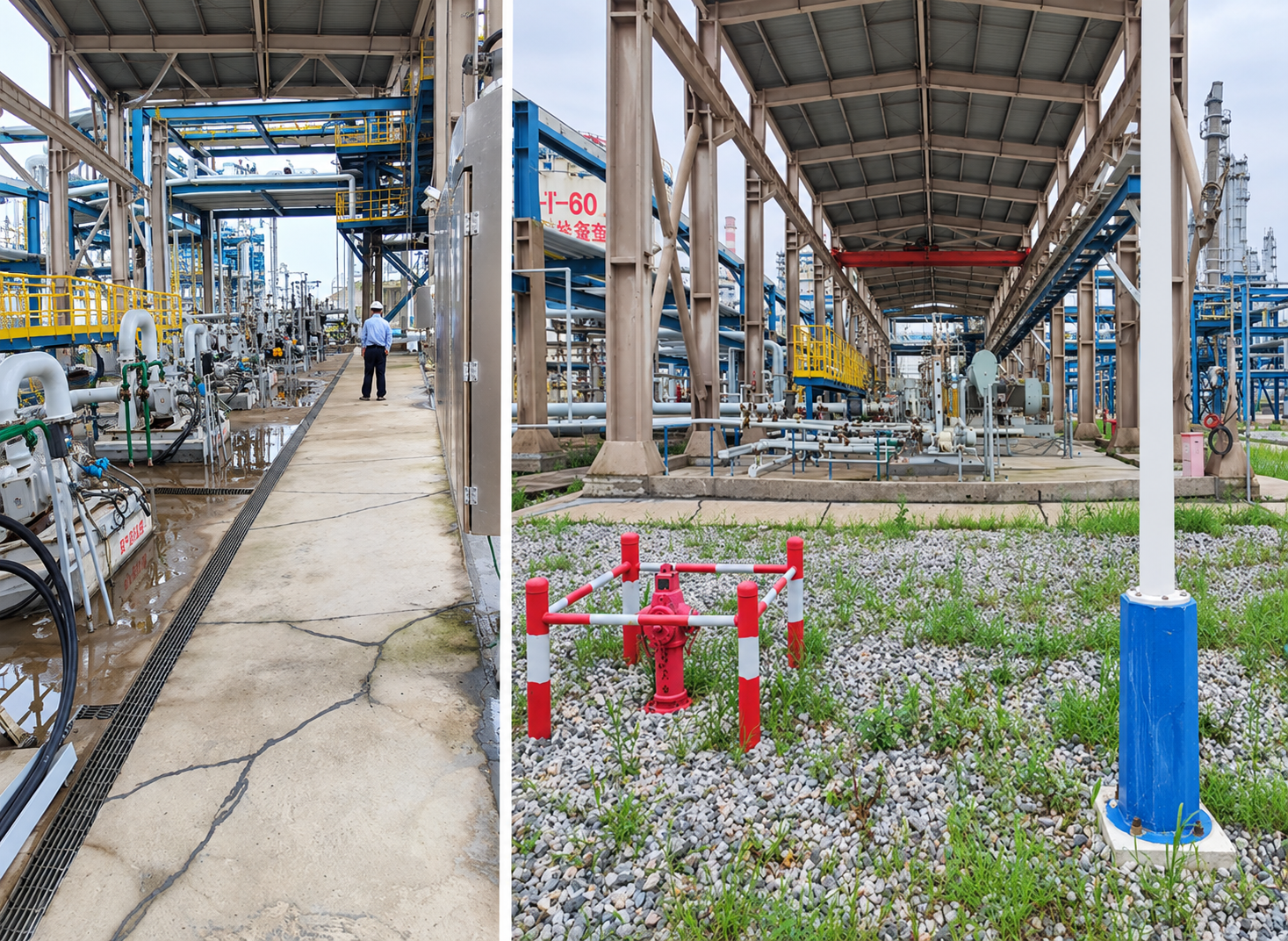
The available construction space was extremely restricted. The narrowest working area measured only approximately 0.6 metres, while overhead pipework, equipment and structural components created additional vertical-clearance limitations. Conventional piling and ground improvement equipment could not operate effectively within these constraints.
The works were also located in the core area of an operating petrochemical installation, where numerous potential hazards were present. Construction activities therefore had to comply with stringent safety controls and avoid interference with existing equipment, pipelines and operating systems.
All site activities were governed by the facility’s permit-to-work system. The resulting construction windows were limited, placing significant pressure on equipment mobilisation, drilling efficiency and coordination between individual work stages.
Production continued throughout the construction period, and the surrounding equipment remained in operation. The remediation works therefore had to be closely coordinated with the plant operations team and adjusted to the facility’s production schedule.
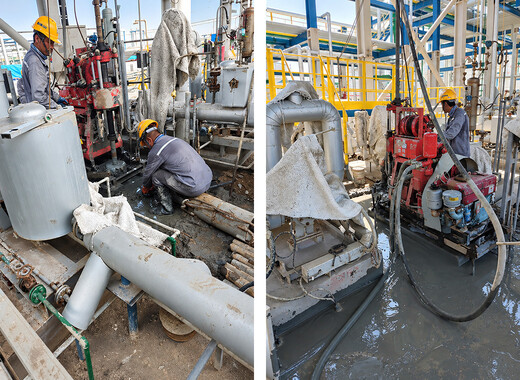
QUAMBO developed a compact underpinning system combining purpose-built low-access installation equipment, grouted crushed-stone steel pipe piles and reinforced-concrete ground beams.
The solution was designed to transfer additional foundation loads through the compressible reclaimed ground to the underlying weathered granite, while structurally connecting adjacent pump foundations to control further differential movement.
Purpose-Built Equipment for Restricted Access
To overcome the severe spatial constraints, QUAMBO developed two types of specialised installation equipment.
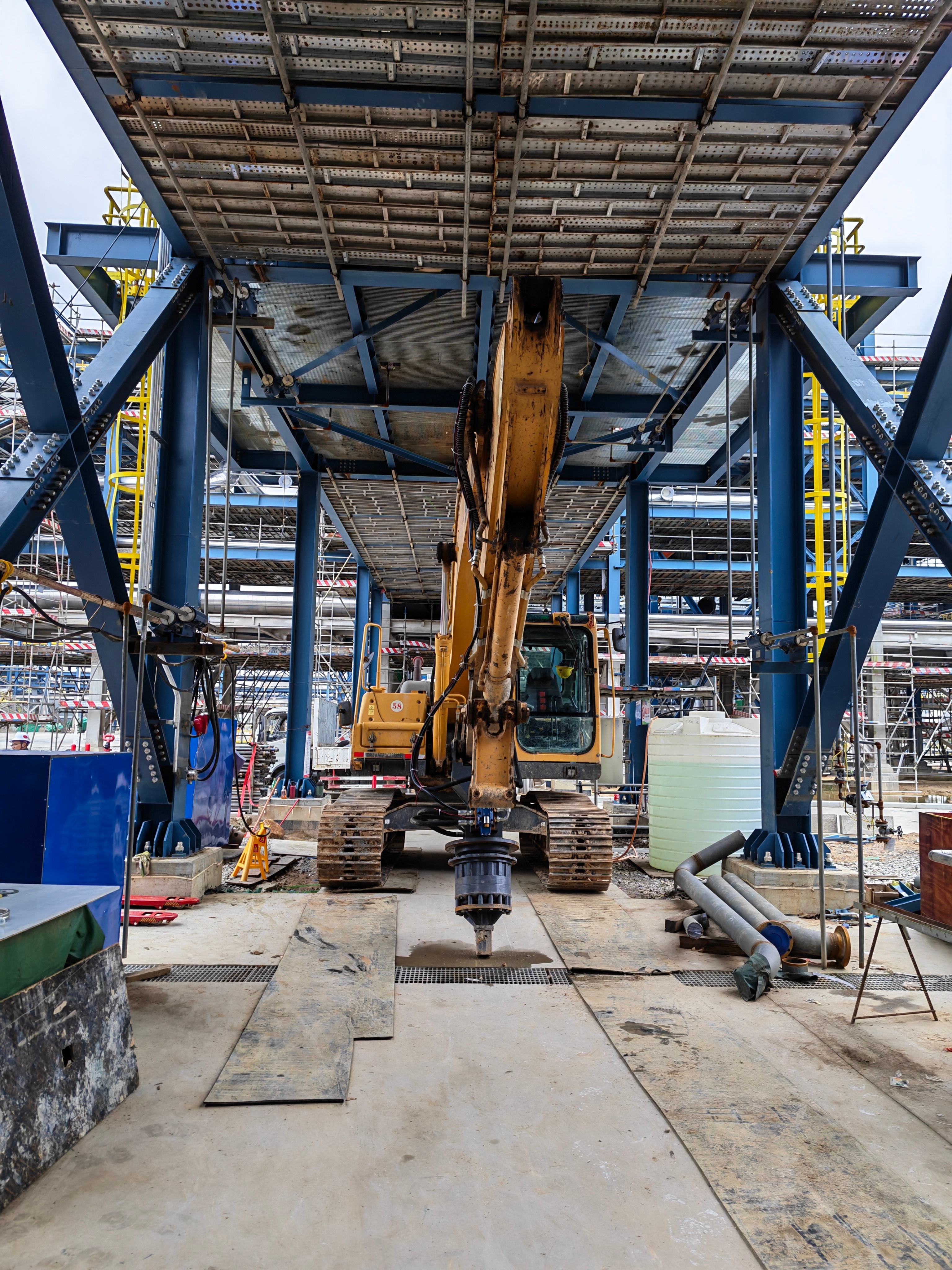
A compact piling machine with an overall width of approximately 0.9 metres was developed for working areas with a clear width of at least 0.9 metres. Its reduced footprint allowed pile installation to proceed between existing process equipment and pipework where conventional machinery could not be accommodated.
For areas narrower than 0.9 metres or surrounded by densely arranged operating equipment, QUAMBO developed an excavator-mounted rotary drive head. The flexible equipment configuration allowed drilling and pile installation to be carried out within highly restricted spaces while minimising interference with the surrounding facilities.
Grouted Crushed-Stone Steel Pipe Piles
The foundation reinforcement system incorporated grouted crushed-stone steel pipe piles as the principal load-transfer elements.
The preliminary pile length was approximately 25 metres. During installation, the pile toe level was controlled by requiring penetration of at least 2 metres into highly weathered or completely weathered granite. The specified characteristic axial bearing capacity was 180 kN.
By transferring load through the reclaimed fill and weaker underlying soils to the weathered rock bearing layer, the piles provided additional support beneath the affected pump foundations.
Integrated Ground-Beam Reinforcement
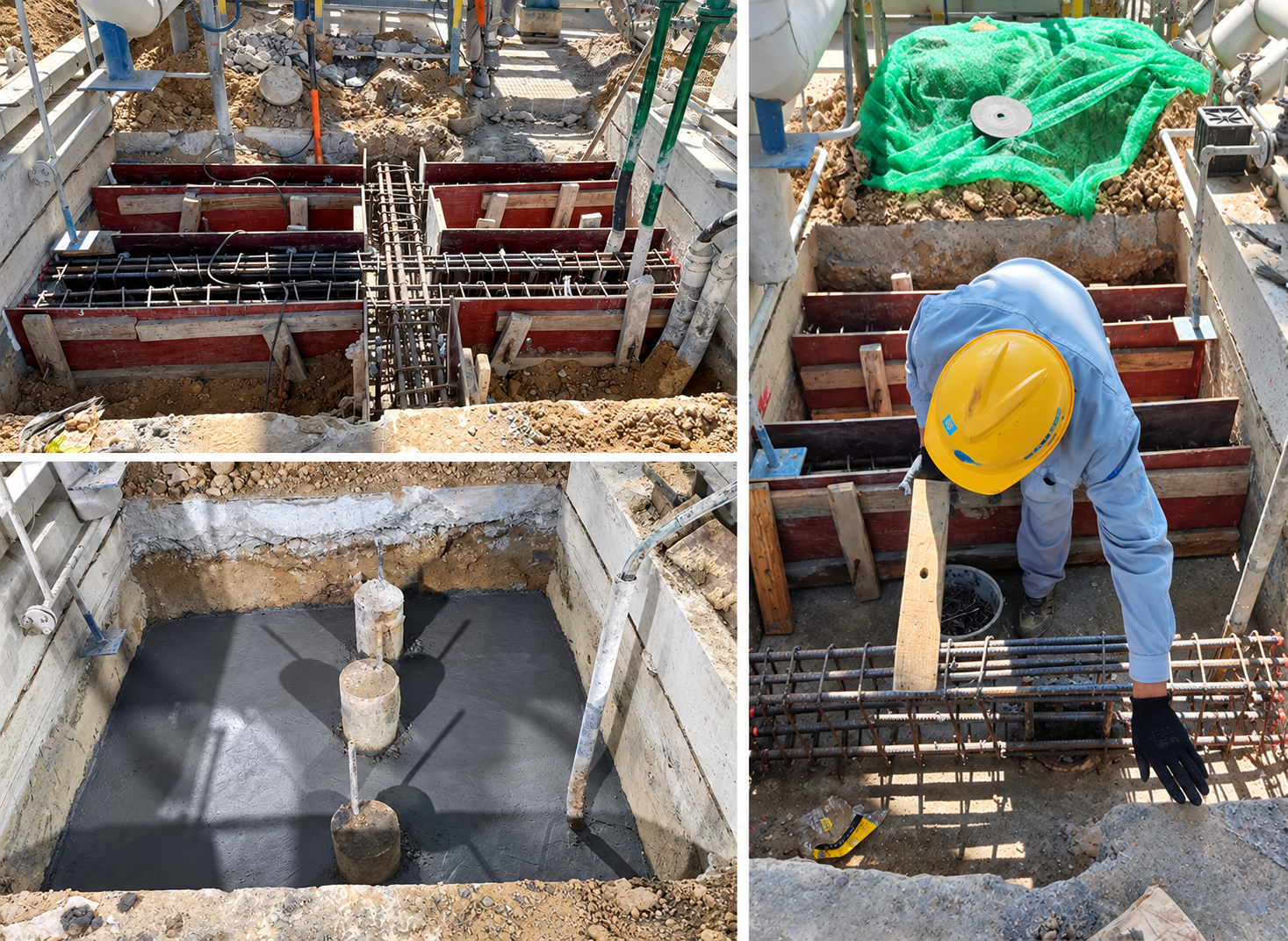
Three steel pipe piles were installed between each pair of adjacent pump foundations. Three reinforced-concrete ground beams were then constructed across the pile heads to form a structural connection between the two foundations.
Post-installed reinforcing bars were used to connect the new ground beams to the existing pump foundations. This allowed foundation loads to be transferred into the steel pipe piles and helped control further settlement and differential movement between adjacent equipment foundations.
Construction Within an Operating Facility
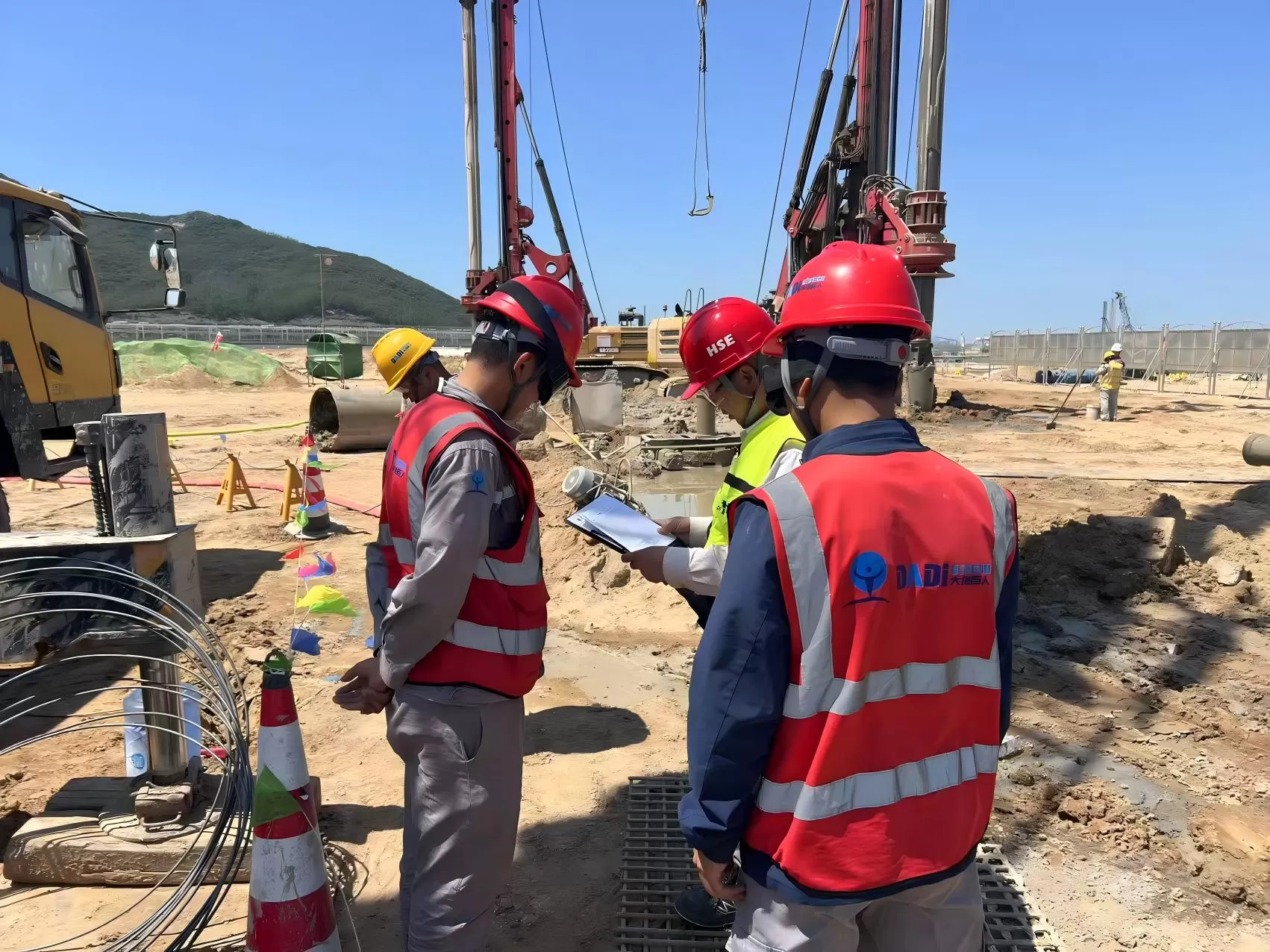
The equipment arrangement and construction sequence were developed specifically for implementation within a live petrochemical plant.
Individual work activities were coordinated with the permit-to-work system and the operating schedule of the facility. Compact equipment and localised excavation reduced the construction footprint, allowing the reinforcement works to proceed around operating pumps, pipelines and structural components.
By integrating specialised equipment with a targeted pile-and-ground-beam system, QUAMBO provided a practical reinforcement solution for significantly settled pump foundations under severe access, safety and operational constraints.
Understand related technologies >


-
SolutionsIndustrial Foundation Strengthening
-
MarketsIndustrial & Manufacturing
Adisseo Quanzhou Methionine Project Pump Foundation Strengthening
 Quanhui Petrochemical Industrial Park, Dongqiao Town, Hui’an County, Quanzhou, Fujian Province, China.